

Humor in Inventory
Counting stock is genuinely funny sometimes, in a way that only people who've done it understand. We've been adding comics to the Yuneva site — real scenarios, not clip art of smiling warehouse workers. If you've ever sworn at a cycle count, some of these will hit close to home.

Can Green Supply Chain KPIs Still Mean Lost Profits?
A dashboard full of green squares is not the same as a profitable quarter. You can hit 98% OTIF by expediting everything. You can hit 99% fill rate by sitting on inventory nobody ordered. You can hit zero stockouts by writing a very expensive cheque every Friday. KPIs measure what operations did. They don't measure what it cost to do it. When ops and finance report on different scoreboards, someone eventually notices the gap — usually the CFO, usually late. If your supply chain scorecard doesn't include a cost line next to every service line, you're not measuring performance. You're measuring effort.

3PL Client Portal: Key Features for Visibility
Every 3PL sales deck has a slide about the client portal. Every client, six months in, has a folder of emails to Karen. A real portal shows live inventory by SKU and lot, itemized billing you can reconcile without a phone call, and SLA performance updated more than once per quarter. If any of those three are missing, you don't have a portal. You have a login page.

2PL vs 3PL: What’s the Difference?
Every logistics glossary defines 2PL and 3PL the same way: assets, services, contracts, scope. The real definition is operational. A 2PL is who you call when the truck is late. A 3PL is who you call when the truck is late AND the pick is short AND the ASN doesn't match. Different phone number, different 3am. Pick your partner based on which call you'd rather make.

Inventory Is Cash. Count It Right.
Every pallet on your floor is cash you already spent. Every phantom unit on the WMS is cash you can't spend again. The difference between "we have plenty" and "we have $8M frozen in slow-movers" is one honest count. Count the stock. Free the capital.

Why Peak Season Breaks Online Order Fulfillment
Every peak season debrief ends the same way. Someone asks what we'll change. Someone else shrugs. The forecast is wrong, the temps are green, the vendor ships to the wrong dock, and the slot count is a suggestion. None of this is new. We just re-live it every November. The struggle isn't that peak is hard. It's that we treat it like weather instead of a system.

Getting off spreadsheets: what to put in place before you outgrow them
Spreadsheets don't fail loudly. They quietly become the system, and then one person goes on vacation and receiving stops. The move isn't to rip out the sheet on day one. It's to notice which tabs are now load-bearing, write down the rules that only live in someone's head, and get counts, locations, and tolerances into something that survives a Tuesday. If your operation runs on one file and one Kevin, you don't have a process. You have a hostage situation.

Your warehouse isn't slow. It's waiting
When units per hour drop, the first suspect is always the picker. So follow one. At 9:14 they’re waiting on a replen from bulk. Bulk is waiting on a putaway to clear the slot. Putaway is waiting on receiving, and receiving is waiting on the system to release the ASN. Nobody is slow. Everybody is waiting on somebody else, in a very orderly queue. Push the picker harder and they just reach the back of it sooner.

Lowest inventory isn't the goal - The right position is
Somewhere between 'too much stock' and 'no stock' there's a number that keeps the lines running and the customers happy. That number is almost never zero. Lean isn't a leaderboard. The win isn't the smallest pile — it's the right pile, in the right slot, at the right time. Everything else is just expensive air freight with a nicer name.
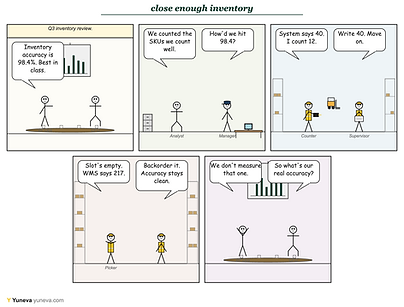
Are Your Inventory Numbers Really Accurate?
Every warehouse I've walked has an inventory accuracy number on a slide somewhere. And every warehouse I've walked has a second, quieter number that nobody puts on a slide. The gap between those two numbers is where the backorders live.

How do I choose the best ERP for inventory management?
Every ERP selection I've watched follows the same arc. A 400-line requirements doc. Demos where every vendor says yes to everything. A scoring spreadsheet nobody trusts. And then a decision made in a hallway. The best ERP for inventory management is usually the one your team actually ends up working around the least. Which you find out about 18 months after signing. Pick with your eyes open. And keep the spreadsheet.